JOURNAL · POST #003 · CRISIS & RISK MANAGEMENT
The Gottwald Crisis Matrix™ —
How 4 Quadrants in 72 Hours Decide Your Company's Survival
1. Why 22 Years in a Matrix
Most entrepreneurs know they have risks. Very few know which ones could existentially threaten them in the next 72 hours.
After two decades of entrepreneurial practice, Mathias Gottwald recognized a recurring pattern: Every crisis follows the same basic dynamics — regardless of industry, size, or location. Whether insolvency, supply chain breakdown, or geopolitical shock — the mechanisms are identical. What's missing is a framework that makes these dynamics visible. Not academic theory. Lived experience.
On June 17, 2017, Gottwald experienced a near-death experience. Since then, his perspective on risk has fundamentally changed. What he developed in the years that followed became the Gottwald Crisis Matrix™.
2. The 4 Quadrants Overview
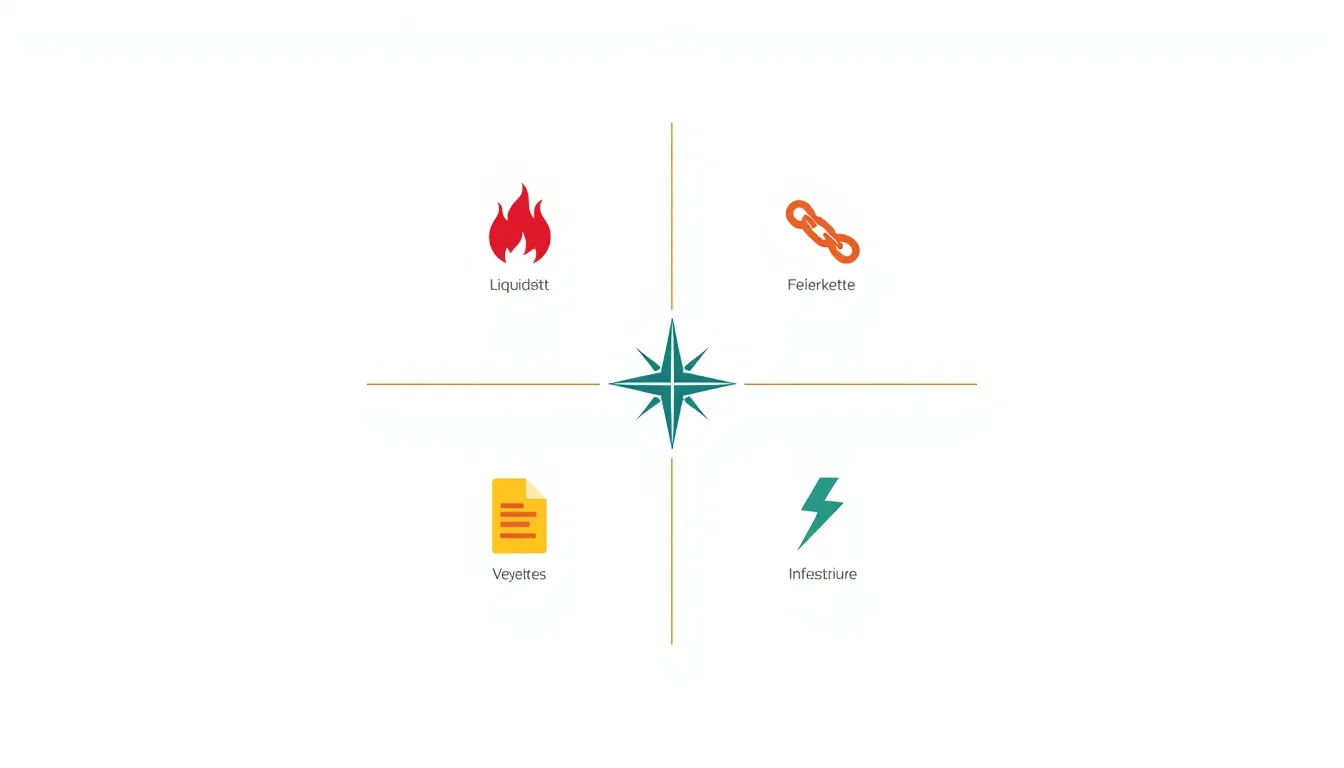
The matrix categorizes every business risk on two axes: Urgency (how quickly must action be taken?) and Impact (how severe are the consequences?). This creates four action quadrants — each with its own logic, timeframe, and priority.
Q1 · ACT NOW
Liquidity
High impact + high urgency. Calculate runway, secure credit lines, ensure cash. Hours count.
Q2 · THIS WEEK
Supply Chain
High impact + medium urgency. Rank top-10 suppliers, identify alternatives, build minimum inventory.
Q3 · THIS MONTH
Contracts
Medium impact + medium urgency. Review force majeure clauses, price escalation clauses, know termination periods.
Q4 · MEDIUM-TERM
Infrastructure
Strategic impact. Energy share of OPEX, IT backup, location risks, geographic diversification.
3. Quadrant 1 — Liquidity
How many months can the company survive without new revenue? This is the first question Gottwald asks every entrepreneur. Most don't know the answer. In Q1, clarity is created: account balance, outstanding receivables, running costs, credit lines.
Gottwald's recommendation: Calculate runway — honestly, not optimistically. Request credit lines from your house bank before the bank addresses it on its own. Renegotiate payment terms with suppliers and customers. In a war economy, cash isn't king — cash is oxygen.
4. Quadrant 2 — Supply Chain
Who supplies the most critical inputs? What happens if one fails? Does the company have alternatives? Q2 of the crisis matrix identifies the dependencies that make you vulnerable.
The Strait of Hormuz is 90% disrupted. The defense industry has priority for raw materials. Europe's supply chains are being restructured not for efficiency, but for defense relevance. Gottwald recommends: Rank top-10 suppliers by degree of dependency, immediately research alternative sources for the top-3, build minimum inventory for critical components.
5. Quadrant 3 — Contracts
Force majeure clauses, termination periods, price adjustment mechanisms — most SME contracts in the DACH region were written in a world that no longer exists. In Q3, the matrix checks whether the contract landscape protects the company or whether it's a ticking time bomb.
Energy prices fluctuate ±40%. Does the lease have a price escalation clause? Can the largest customer cancel within 30 days? These questions decide over months, not years.
6. Quadrant 4 — Energy & Infrastructure
What does energy cost as a share of revenue? What happens with a +40% price increase? Are there alternative locations? Q4 is the strategic quadrant — this is where medium-term decisions are made that will impact the next 2–5 years.
Q4 is also the quadrant where crises become opportunities. Quantum Systems Munich raised €160 million in a crisis. Those who know infrastructure dependencies and move faster than the market position themselves on the winning side.
7. The 72-Hour Emergency Routine
Gottwald has translated the crisis matrix into a concrete 72-hour routine. Three phases, clear priorities:
Secure liquidity. Calculate runway. Identify top-5 suppliers. Brief team on crisis mode. No panic — clarity.
Review contracts. Contact alternative suppliers for top-3 inputs. Request emergency credit line from house bank. Check StaRUG compliance.
Identify war economy opportunities for your industry. Research EU funding programs EDIP. Evaluate holding structure and asset distribution. Book consultation.
8. When External Support is Critical
The expert is clear: When two or more quadrants are simultaneously critical, internal management is no longer sufficient. Then you need someone from outside — not as a consultant who delivers presentations, but as a solution finder who accompanies you.
Gottwald has been accompanying entrepreneurs through crises for 22 years. Not with PowerPoints. With decisions. In 33 minutes, you can determine together which quadrant the company is in — and what the next 72 hours concretely mean.
Where does your company stand in the matrix?
In 33 minutes you'll know. Free. Without pitch.
Further reading: War Economy 2026 — What SMEs Must Do Now →
Leo Maran writes about risk management, crisis strategies and entrepreneurial resilience on behalf of GOTT WALD Holding LLC.
Sources: KSV1870, OECD, EU Parliament, UNCTAD, US State Dept. — April 2026